

The Hawker P.1121: Britain's Lost Mach 2.5 Fighter
By the editors at Habilitate.Club
In the annals of British aviation, few aircraft carry the bittersweet weight of "what might have been" quite like the Hawker P.1121. Conceived by the legendary Sir Sydney Camm as the spiritual successor to the Hawker Hunter, the P.1121 was poised to become the Royal Air Force's premier Mach 2.5 strike fighter — only to be felled by politics before it ever left the ground.
A Vision of Supersonic Supremacy
The story begins in the early 1950s, when the Air Ministry issued Specification F.155T calling for a high-altitude, rapid-climbing interceptor capable of meeting the Soviet threat. Camm's team at Hawker responded with an ambitious design: a sleek, delta-winged machine powered by the revolutionary de Havilland Gyron turbojet, producing an astonishing 27,000 lb of thrust with reheat. By 1957, the design had evolved to meet Operational Requirement OR.339 — a Mach 2.5 all-weather strike fighter that would have given the RAF a capability rivalling anything in the American or Soviet arsenals.
The P.1121 was remarkably advanced for its era. It featured a sophisticated radar and fire-control system, provision for cutting-edge air-to-air missiles like Red Dean and Red Hebe, and a weapons bay capable of carrying nuclear or conventional stores. With a projected top speed of 1,500 mph and a service ceiling above 60,000 feet, it would have been the pinnacle of British fighter design.
The Mockup That Never Flew
Despite the cancellation of the Gyron engine programme, Hawker pressed on. A full-scale mockup was completed at their Kingston factory, and construction of the first prototype was well underway by late 1957. Workers had assembled the forward fuselage, and the aircraft was taking shape in the hangar — a gleaming white sentinel of Britain's aerospace ambition.
Then came the infamous 1957 Defence White Paper. Minister of Defence Duncan Sandys declared that manned combat aircraft were obsolete, that future wars would be fought with guided missiles alone. In a single stroke of the pen, the P.1121, along with dozens of other promising projects, was cancelled. The mockup was broken up, the tooling scrapped, and Camm's last fighter was consigned to history.
Surviving in Memory: Museum Projects
Though no P.1121 ever flew, fragments of the project survive in Britain's aviation museums — testament to the enduring fascination with this lost aircraft.
The Midland Air Museum near Coventry holds a detailed model of the P.1121 prototype, preserving the aircraft's distinctive lines for visitors to appreciate. Meanwhile, the RAF Museum Cosford displays a model of the P.1103 — the direct predecessor to the P.1121 and Camm's initial response to the F.155 specification. Together, these exhibits tell the story of an evolutionary line cut tragically short.
At Brooklands Museum, the spiritual home of Hawker aircraft, enthusiasts continue to research and document the P.1121 programme, ensuring that the work of the Kingston design team is not forgotten.
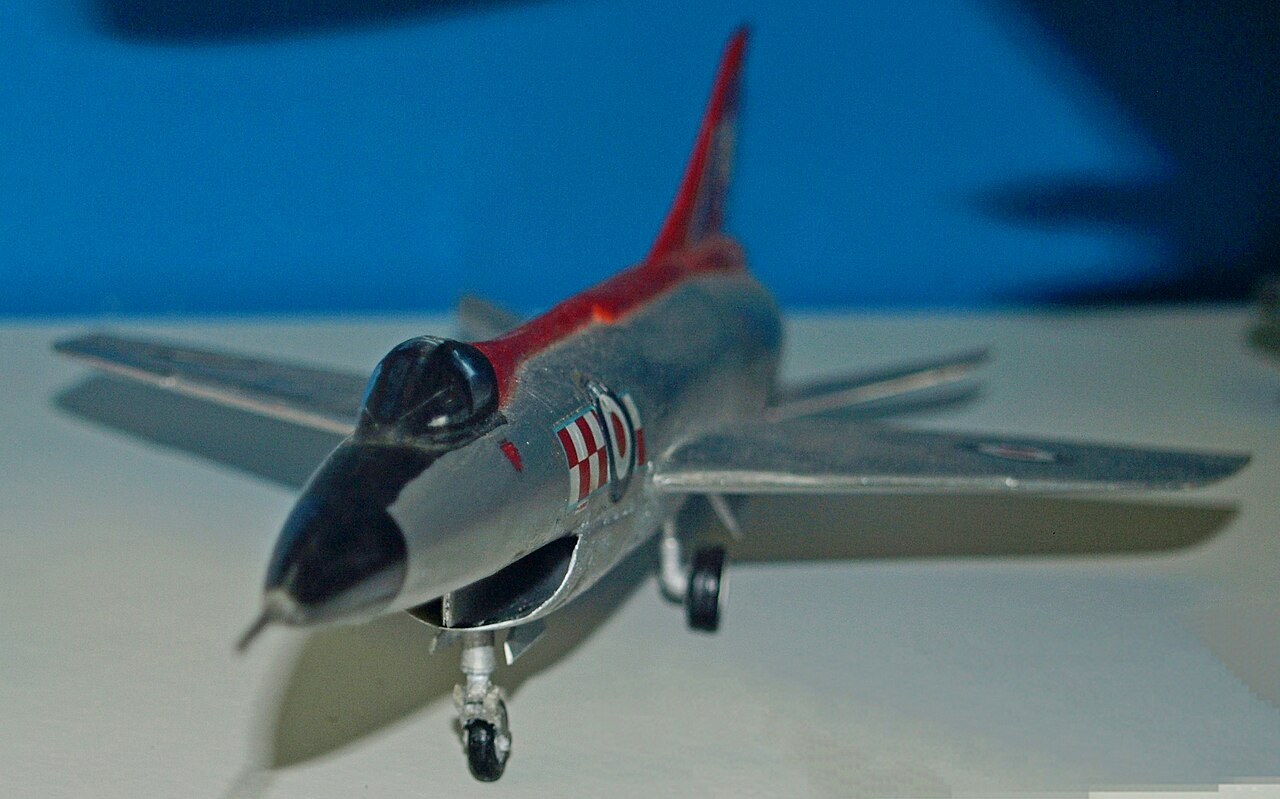
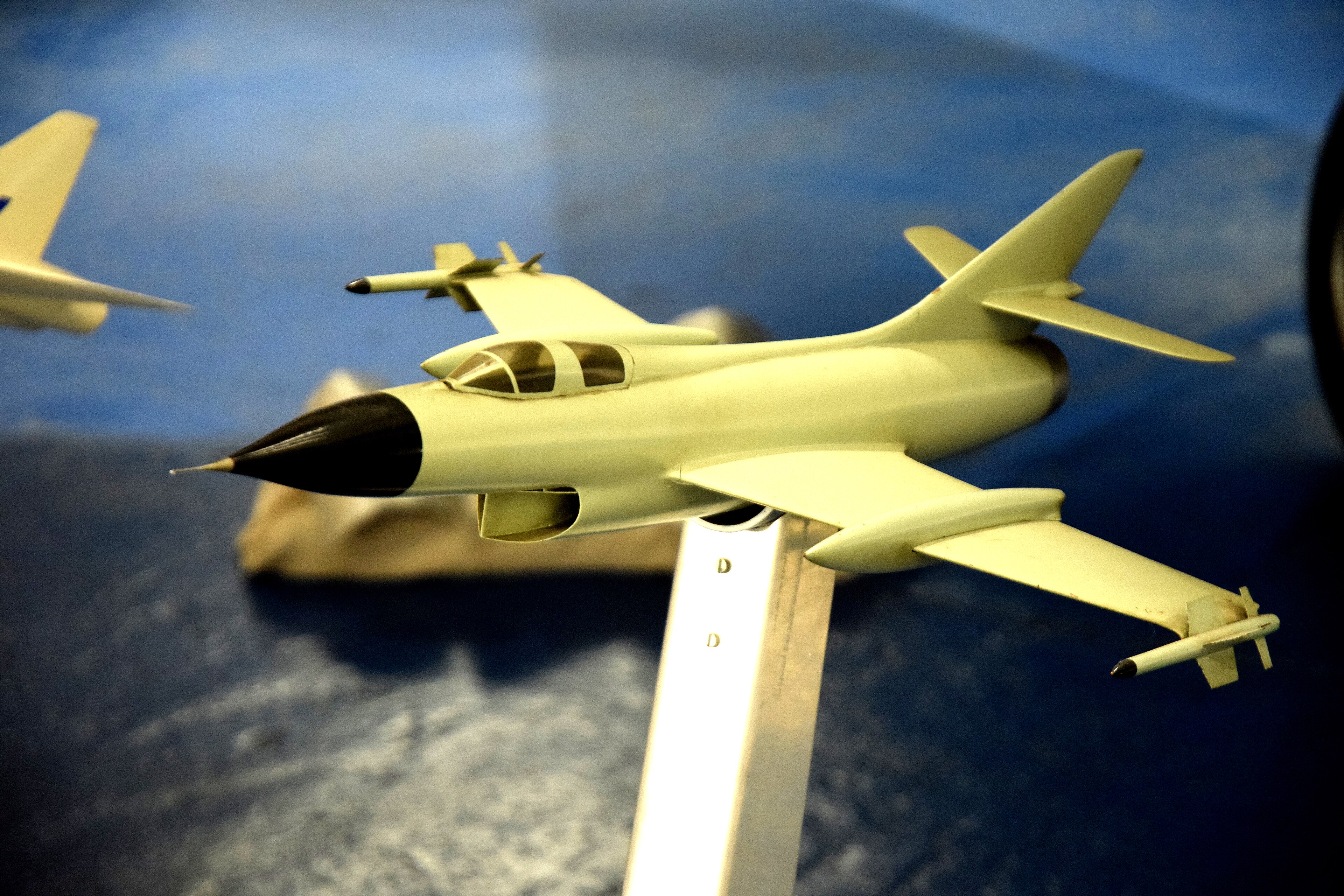
Above: P.1121 model at Midland Air Museum (Public Domain, Wikimedia Commons); P.1103 model at RAF Museum Cosford (CC BY-SA 2.0, David Merrett)
Technical Overview
The P.1121's design was a masterclass in 1950s aerodynamic thinking. The aircraft featured a sharply swept wing, area-ruled fuselage, and a T-tail configuration that gave it an unmistakable profile. The technical drawings produced by Hawker's design office remain some of the most detailed and beautiful of the era — a reminder of the draftsmanship that underpinned the jet age.
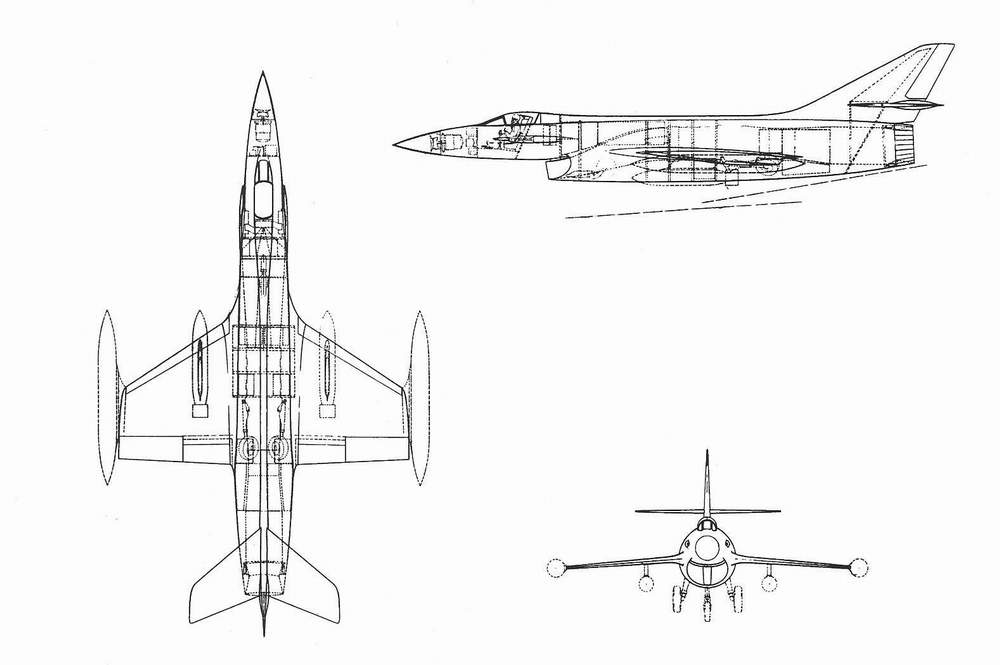
Three-view general arrangement drawing of the Hawker P.1121 (Crown Copyright)
| Feature | Specification |
|---|---|
| Role | All-weather strike fighter / interceptor |
| Designer | Sir Sydney Camm |
| Powerplant | 1 × de Havilland Gyron (27,000 lb thrust with reheat) |
| Max Speed | Mach 2.5 (~1,500 mph) |
| Crew | 2 (pilot and navigator/radar operator) |
| Armament | Air-to-air missiles, internal weapons bay |
| Status | Cancelled 1958; mockup only |
Building the Dream: Plastic Model Kits
For modellers, the Hawker P.1121 has long held a special place in the "what-if" canon — an aircraft so close to reality that building it feels like completing history. Over the years, a small but dedicated range of kits has allowed enthusiasts to put Camm's lost fighter together with their own hands.
The earliest widely available kit came from Maintrack Models in their Project X range. Released in the 1990s as PX-011 in 1/72 scale, this was a vacform kit with white metal detail parts, mastered by Gordon Stevens of Rareplane fame. Though demanding by modern standards, it gave modellers their first real chance to recreate the P.1121's distinctive lines. The kit remains a sought-after collector's item today.
More recently, Whirlykits offered an updated version of the Maintrack P.1121 with some enhanced resin parts, as WPX72017, keeping the subject available for a new generation of builders.
In 2011, S&M Models released SMK72-04, a 1/72 resin kit that represented a significant step forward in quality and detail. As a new-tool offering, it captured the P.1121's shape with greater accuracy and provided a more accessible build experience for those who wanted to add this phantom fighter to their shelf.
For those who prefer working in wood, the Vintage Model Company produces a 10-inch wingspan laser-cut balsa replica kit designed by Steve Bage — a fitting tribute to an aircraft that existed only in mockup form.
The P.1121 also attracts the attention of 3D-printing enthusiasts in the what-if modelling community, with contemporary builders producing their own interpretations of Camm's design. In this way, the aircraft that never flew continues to take shape in workshops around the world.
A Legacy Reimagined
More than six decades after its cancellation, the P.1121 continues to captivate aviation historians and enthusiasts. Its story is a poignant reminder of how political decisions can alter the trajectory of technological progress — and how close Britain came to fielding a world-beating supersonic fighter.
At Habilitate.Club, we believe the P.1121 deserves more than a footnote in history. Its bold lines and pioneering spirit have inspired a range of carefully crafted products that let enthusiasts keep this remarkable aircraft alive in their own collections — from detailed apparel to scale replicas that honour Camm's final masterpiece.
The Hawker P.1121 may never have taken to the skies, but in the hearts of those who remember it — and in the model workshops where it finally gets built — it flies still.
Discover more aviation history and explore our exclusive P.1121-inspired collection at Habilitate.Club.
Main image: P.1121 mockup under construction at Kingston (Crown Copyright)