Habilitate Club
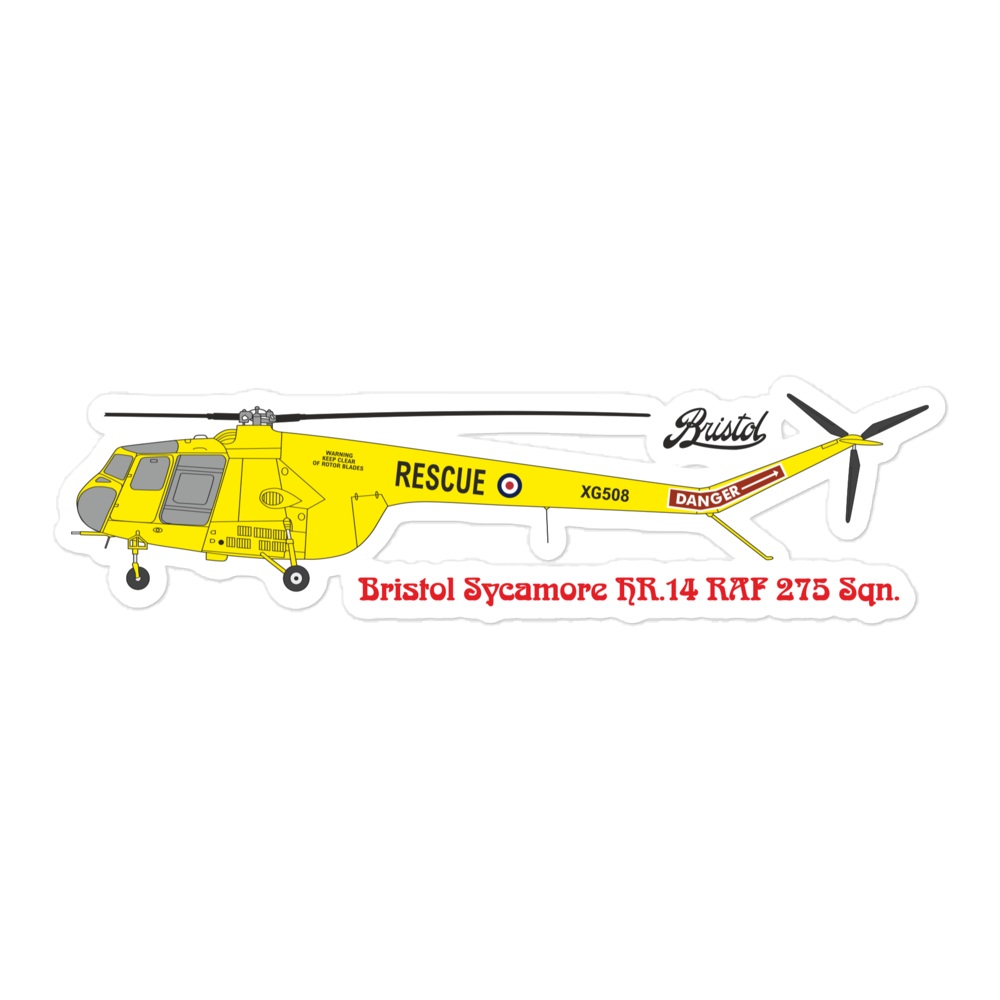
Bristol Sycamore HR.14 RAF 275 Sqn. Bubble-free stickers
Bristol Sycamore HR.14 RAF 275 Sqn. Bubble-free stickers
Couldn't load pickup availability
The Bristol Sycamore HR.14 in the markings of No. 275 Squadron represents one of the most significant moments in the entire history of British military aviation — the birth of the RAF's search and rescue helicopter service. On 1 March 1953, No. 275 Squadron reformed at RAF Linton-on-Ouse, becoming the first Royal Air Force search and rescue helicopter squadron, equipped with the Bristol Sycamore HR.13 and HR.14. The catalyst for its formation had been twofold: the success of the Far East Air Force Casualty Evacuation Flight in evacuating wounded troops from otherwise inaccessible jungle locations during the Malayan Emergency, and the extraordinary rescue operation in January 1953 when catastrophic floods in Holland saw RAF helicopter crews rescue more than 800 civilians. These two events made the case for dedicated helicopter SAR cover so compellingly that the RAF could no longer delay. With a full complement of 15 Sycamores in six Flights by the end of 1953, the squadron had detachments at Leuchars, North Coates, Horsham St Faith and Chivenor, covering the North Sea and the English coastline, with typical duties including rescuing civilian bathers and covering military aircraft in difficulty.
The crews of 275 Squadron were pioneers in every sense — writing the procedures, developing the techniques, and learning the hard lessons that all subsequent RAF SAR crews would build upon. The Sycamore had originally been designed as an executive transport, and its small two-person cabin presented real challenges for rescue operations: if the winch was sent down on its own the casualty had to fit it themselves, and if the navigator went down on the winch, the pilot had to operate the winch at the same time as flying the helicopter. These were not trivial difficulties over cold North Sea waters in poor visibility — they required exceptional airmanship and nerve from men who had no manual to refer to. The first rescue carried out by 275 Squadron was of a Venom pilot recovered from Boulmer to Acklington in August 1953 — the first of countless lives that the Sycamore and the men who flew it would save over the years that followed. In June 1953, a Sycamore towing a large RAF Ensign led a flypast by 640 British and Commonwealth aircraft at the Coronation Review of the RAF — a proud and fitting symbol of a service that had just made history. The squadron later relocated to RAF Thornaby and then RAF Leconfield, converting to the Whirlwind HAR.4 in March 1959 before being renumbered No. 228 Squadron on 1 September 1959 — a lineage of rescue that has never been broken and continues to this day. The yellow Sycamore HR.14 with its bold "RESCUE" markings is more than a helicopter; it is the founding symbol of a tradition that has saved thousands of British lives.
Product details:
• High opacity film that’s impossible to see through
• Fast and easy bubble-free application
• Durable vinyl
• 95µ density
Don't forget to clean the surface before applying the sticker.
This product is made especially for you as soon as you place an order, which is why it takes us a bit longer to deliver it to you. Making products on demand instead of in bulk helps reduce overproduction, so thank you for making thoughtful purchasing decisions!